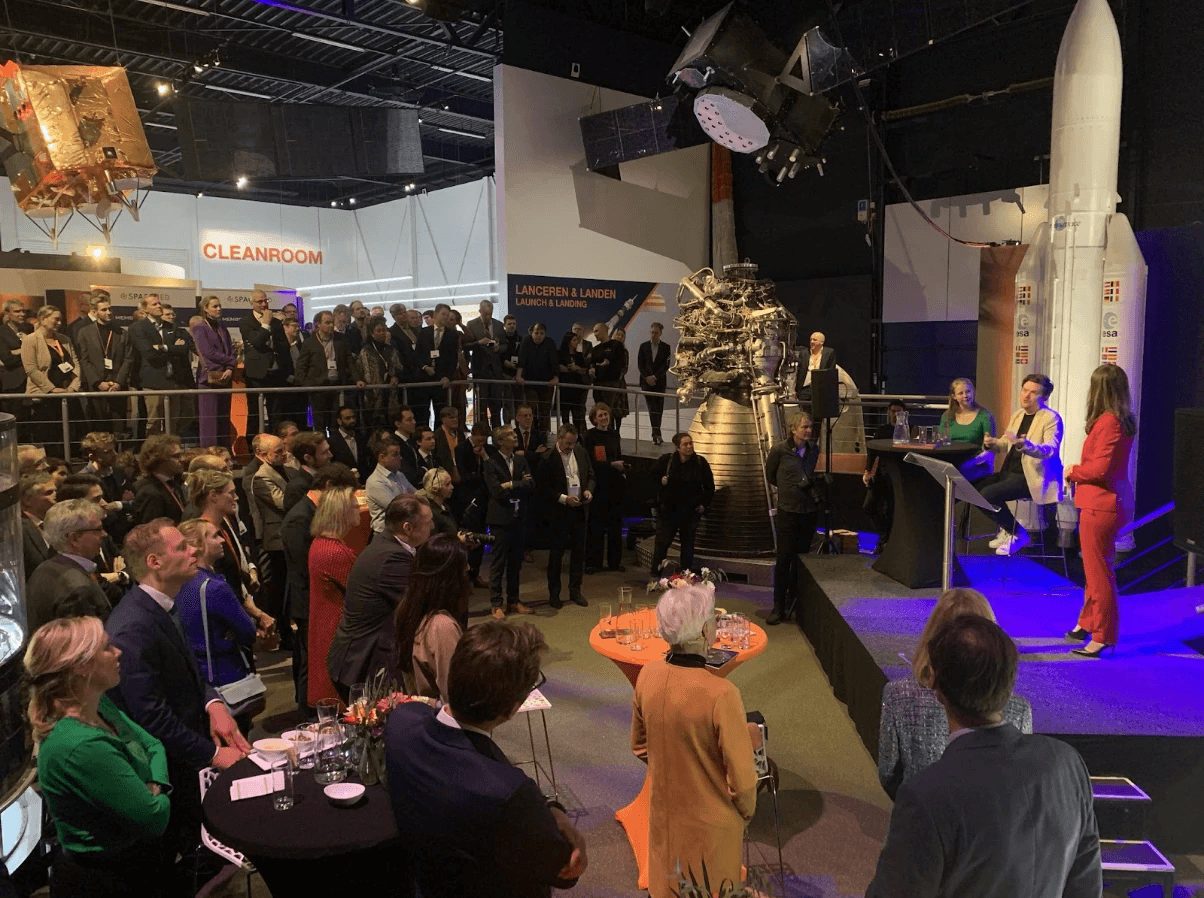
The international position of the Netherlands in the space sector is under pressure and requires a new impetus. Addressing this requires a collaborative effort among the government, businesses, and the scientific community, including the integration of civilian and military applications. These objectives are outlined in the newly presented long-term space agenda.
The Long-Term Space Agenda was presented to Minister Micky Adriaansens at Space Expo Noordwijk. With the launch of this agenda, parties emphasise the strategic importance of space travel as critical infrastructure for the Netherlands. The Netherlands has a unique knowledge and technological position to excel in the rapidly growing space economy.
As part of the announcement, our CEO Thomas Parry had the opportunity to pitch our company to a delegation including the state secretary of Defence Christophe van der Maat, while our then-CCO Bastiaan Bom was invited to be part of a panel to explain the potential of the commercial space market.
The long-term space agenda, supported by five involved ministries (Economic Affairs and Climate, Defense, Infrastructure and Water Management, Foreign Affairs, Education, Culture and Science), was developed in cooperation with industry, academia, and various regions, under the leadership of Maria van der Hoeven. The agenda has been submitted to the House of Representatives by Minister Micky Adriaansens (Economic Affairs and Climate).
Space technology and satellite data are increasingly indispensable for infrastructure, climate science, and security. Investing in space is essential for reducing strategic dependencies and contributes to job creation and income in the Netherlands.
Key missions in the Long-Term Space Agenda:
1. Safety and military capability: develop satellite communication,
navigation, and earth observation technologies.
2. Climate leadership: lead in emissions measurement and the use of
satellite data for water and agriculture.
3. Scientific development: create high-quality space instruments and
transfer this knowledge to marketable non-space technologies.
4. Data utilisation: improve the use of satellite data by governments
and service providers.
5. Economic growth: grow the sector's revenue and make better use of
the NL Space Campus.
6. International regulations: promote additional UN agreements for
well-regulated space usage.
Minister Adriaansens emphasised the critical role of space technologies in infrastructure, safety, climate goals, and the economy, advocating for continued significant investment in the sector.
Dutch public investments in European and national space programmes support over 10,000 jobs in the Netherlands.